Tax Liens affect any property owner who falls behind on local taxes, and Greenville’s Tax Collector office makes the tax lien search straightforward through its online portal. By entering a parcel number, owner name, or tax account, users can view tax lien records, see the lien amount, date, and status, and learn how to check if a lien has been released. Quick access helps buyers, sellers, and lenders avoid surprise encumbrances before a transaction closes.
Tax Liens can be cleared once the outstanding balance, penalties, and interest are paid, and the county then records a release document that updates public records. Homeowners can request a certified copy of the release, verify the removal online, and ensure title searches reflect the satisfied lien. Understanding these steps protects real estate investments and streamlines refinancing or title clearance in Greenville, SC.
How to Search Tax Liens
Tax lien searches in Greenville County begin with the official Tax Collector portal. A parcel number, owner name, tax account number, or property address can help narrow a property record and show whether a tax balance or lien entry needs review. Users can also check greenville county sc for official county government information. The result helps buyers, owners, lenders, and closing teams spot an unpaid tax claim before a sale, refinance, or title transfer. Recorded lien documents and legal lien priority may require a separate official records request.
Official Search Portal: https://greenvillecountysc.gov/TaxCollector/
Steps to Search
- Open the official Greenville County Tax Collector website and select the current property or tax search option.
- Enter the parcel number, owner name, tax account number, or property address, depending on the available search fields.
- Compare the results with your documents, checking the property address, owner, parcel ID, tax account number, and tax year.
- Review the balance and separate unpaid taxes from payments, credits, penalties, interest, and fees.
- Check the lien status and look for a recording number or lien document. A paid tax account does not always confirm that a recorded lien has been released.
- Search previous tax years when investigating older liens or delinquencies. Contact the Tax Collector for records that are not available online.
- Record the lien date, recording date, document number, and property details when available.
- Save a dated copy of the results for reference, and repeat the search when payments, releases, or ownership changes may affect the information.
Property Identifiers That Prevent a False Match
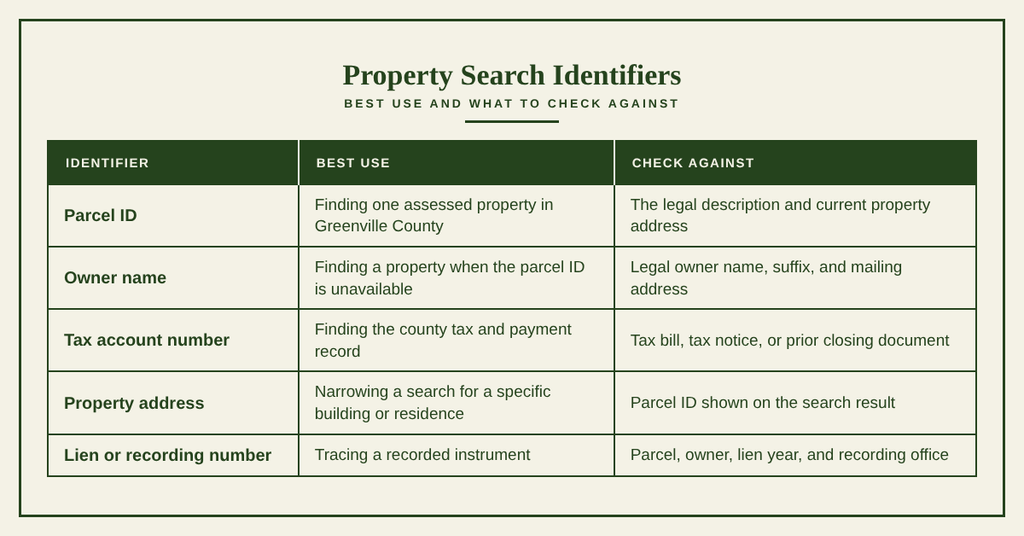
The safest tax lien lookup uses more than one identifier. Names can change, addresses can change, and old documents may carry a parcel number from before a tax map update. A quick cross-check can prevent a request from being tied to the wrong tax account.
What a Complete Tax Lien Record May Show
A tax lien record may include several fields, and each one answers a different question. The exact screen can change as county systems are updated, so treat missing fields as a reason to ask the Tax Collector rather than proof that a record does not exist.
Property tax records may include the property owner, property address, parcel ID, and tax account number. These details help identify the property and its associated tax account. Tax information may show the tax year, original balance, lien amount, and current amount due, including applicable penalties, interest, and fees. The lien date, lien number, recording date, and recording number help locate the official filing.
Lien status indicates the county’s listed status for the tax account. A lien document, satisfaction, or release can help verify whether the lien has been resolved. Always confirm current balances and lien status with the responsible county office.
When a Recorded Document Is Still Needed
The tax portal and the county recording system serve different purposes. The tax portal can show a balance, payment, tax year, and lien status. The recorded document can show the exact legal description, amount stated at recording, execution details, and any later satisfaction or release.
- Write down the parcel ID, owner name, lien year, lien number, and recording number from the tax result.
- Check the portal for a linked lien notice, satisfaction, or release before making a separate records request.
- Ask the Tax Collector which office holds the recorded instrument and whether a document image or certified copy can be requested.
- Request a certified copy from the office that holds the recorded instrument when a lender, title company, court, or closing agent requires certified proof.
- Give the full document to the title company or attorney handling the property so the recorded legal description can be matched with the parcel under review.
Tax Liens and Property Transactions
A property tax lien is a claim against assessed real property. The claim can continue after property ownership changes, so a buyer, seller, lender, or refi borrower needs more than a seller’s statement that the tax account is current. A county tax search works with the title review because the two records answer related but separate questions.
Impact on Buying, Selling, or Refinancing Real Estate
An unresolved tax lien can affect who pays, when funds are released, and whether a title company can clear the property for a new owner. The exact result depends on the lien status, the title record, and the closing terms. Early review gives the parties time to request a payoff figure, obtain a release, or settle a disagreement before signing.
Buyers
A buyer should ask the title or closing team to compare the county tax record with the title report. If an active tax lien appears, the buyer can require a payoff and recorded satisfaction as a condition of closing. This protects the buyer from learning about the claim after the purchase contract is signed.
Sellers
A seller should request a current payoff figure before listing the property or negotiating final proceeds. Paying the tax balance may still leave a recording step, and the seller may need to supply a release document to the title company. Clear records help the seller receive the expected sale proceeds without a last-minute hold.
Refinancing
A lender may require the existing tax lien to be satisfied before it will clear a property for a new mortgage. Some closings can deduct the payoff from the refinance proceeds, while other lenders require payment before funding. The payoff and recording duties should be settled in writing with the lender and title team.
Lien Priority, Title Reviews & Multiple Encumbrances
A county tax record does not decide lien priority by itself. A title review may find a mortgage, deed of trust, judgment lien, federal tax lien, homeowners association claim, mechanic’s lien, or another recorded interest. Each claim can have different dates, legal rules, and record requirements, so a property can carry more than one encumbrance.
South Carolina law and the recorded instruments control priority. A title company or South Carolina attorney can compare the instruments and explain how they affect a proposed sale or loan. A tax lien search remains an important part of that review because it identifies unpaid county tax claims and helps locate the documents used for clearance.
County tax accounts show balances, payments, and lien status. Recorded tax liens provide the lien amount and property details. Title searches reveal ownership history and recorded claims. For closing payoff amounts, contact the Greenville County Tax Collector, title company, lender, or escrow agent.
A tax deed is different from a tax lien. A lien is a claim against property for unpaid taxes, while a tax deed is a deed used within a tax-sale process after required legal steps. References to a tax sale or tax deed on a title report need a professional review because their legal effect differs from an ordinary tax balance or lien release.
Title Clearance & Payoff Requirements Prior to Closing
For an active county tax lien, the usual path is full payment of the verified balance, followed by a recorded release or satisfaction. Users can also reference property owner for additional information. A written agreement, settlement, or court order may handle a disputed claim in another way. The closing team should identify the required method before funds change hands.
- Match the property to the lien record using the parcel ID, legal description, owner name, tax account number, and lien year. Do this before ordering a payoff for a property that may be different from the one under contract.
- Request a date-specific payoff figure from the Greenville County Tax Collector. Ask for a breakdown of delinquent tax principal, payments and credits, penalties, interest, fees, and the tax years included.
- Compare the payoff figure with the tax portal result. A difference may reflect later charges, a different tax year, a partial payment, or a record that has not yet posted.
- Give the payoff details to the title company, closing attorney, lender, or escrow agent handling the transaction. Confirm who will pay the balance and whether payment will occur at or before closing.
- Make the full payment through a method approved by the Tax Collector. Keep the receipt, confirmation number, date, amount, and property identifiers because these records support the payoff request.
- Confirm that the Tax Collector has prepared or recorded the satisfaction or release required for the lien. A payment receipt proves the transaction, while the recorded instrument supports the property record update.
- Have the title team compare the recorded release with the lien that appeared in the title report. Closing can then proceed with an updated title record or a clear plan for any remaining document issue.
Tax Lien Release & Clearance Process
A tax lien release becomes possible after the county confirms that the tax debt covered by the lien has been satisfied. Payment and recording are separate events. The tax account may show money received before the release document is prepared, and the release may reach the recorded index before the tax portal updates its lien label.
Satisfying Outstanding Tax Balances
The amount on a tax account can contain more than a delinquent lien balance. Current-year taxes, future amounts, partial payments, and added charges may appear on the same account. A lien payoff should identify the exact tax years and charges covered by the claim.
- Confirm the tax years that match the recorded lien before paying.
- Ask for a payoff total valid for the expected payment or closing date.
- Check whether the displayed amount includes current taxes that are not part of the lien.
- Do not assume a partial payment releases the claim. Ask the Tax Collector whether partial payment can satisfy a lien and what written action must follow.
- Use the payment method approved by the county and keep proof showing the parcel or tax account that received it.
Recording Official Release & Satisfaction Documents
After full payment, the county records the release or satisfaction document required to clear the tax lien. The Tax Collector can confirm the lien status, the release date, and the recording reference. A lender or title company may request a certified recorded copy to complete its file.
- Send the Tax Collector the lien year, parcel ID, tax account number, and payment receipt if one document is needed to trace the account.
- Ask whether the balance is posted and whether a release or satisfaction has been prepared for recording.
- Request the recording date, recording number, lien number, and document type once the county has completed that step.
- Ask the Tax Collector to identify the office holding the recorded instrument if a certified copy is needed.
- Order the certified copy from the office that holds the record, then compare its legal description, owner, parcel, lien amount, and recording number with the active lien.
- Send the release or certified copy to the title company, attorney, lender, or escrow agent handling the property transaction.
- Ask that party to confirm the title record has been updated or explain which recorded document is still needed for title clearance.
The tax office can still require internal steps after payment, such as posting the receipt, closing the tax account, and preparing the instrument for recording. Those steps can occur in a different order. A dated receipt, payoff statement, and recorded release each answer a different part of the clearance process.
Confirming Removal in Public Property Directories
A cleared tax lien should disappear from active public search results after the county updates the tax account and the recorded document reaches the proper index. Because these are separate systems, one may update before the other. A final check should confirm both the tax status and the recorded release.
- Run a fresh search with the parcel ID and tax account number rather than relying on an earlier result.
- Confirm that the lien status shows released, satisfied, paid, closed, or another county-approved cleared label.
- Check that the balance connected to the delinquent tax years is zero or has an explained payment status.
- Compare the recorded release with the original lien number, legal description, owner, and recording office.
- Ask the title team to update its title review after receiving the recorded document.
- Keep the final search page, document image, certified copy, and a note showing the date of each check.
A zero tax balance and an active lien label should be referred to the Tax Collector. The balance may concern a different charge, or the release may still be moving through the recording process. Written confirmation from the proper office is more dependable than a guessed explanation of the screen.
Record Accuracy & Resolution
Most tax lien search problems fall into four groups: a mismatched property, an incomplete search, a delayed system update, or a dispute about the amount. Sorting the problem into one of these groups prevents a buyer or owner from treating an unexplained result as final proof that no lien exists.
System Processing Delays for Recent Payments or Releases
Payment posting, lien satisfaction, recording, and public search updates can occur at different times. A recent transaction may appear unfinished for part of that process. Processing time can vary by account, payment method, lien year, and recording work, so a same-day update should not be assumed.
Keep the payment confirmation until the release is recorded and the tax record is updated. Calling before the posting or recording step is complete can produce an outdated answer, so include the transaction date when asking the office to review the account.
Resolving Incorrect Parcel Numbers or Mismatched Balances
A wrong parcel or balance often comes from an old tax notice, a recent transfer, a changed owner name, or a document tied to a prior tax map number. Address-based searches can add another error when a building has several parcels or a postal address covers more property than the tax account.
- Write down four identifiers from the disputed record: owner name, parcel ID, tax account number, and legal description.
- Compare them with the current official tax map, assessment record, deed, title report, or closing document.
- Check the current owner and parcel pairing rather than relying on a name printed on an older statement.
- Review whether a transfer, subdivision, reassignment, or tax map change created a new parcel or tax account.
- Contact the Tax Collector with the identifiers and copies of the conflicting records. Ask which record controls the tax account and lien balance.
- Request a correction if the account is tied to the wrong parcel. Keep the case or request reference with the submitted documents.
- Run a new search after the correction and compare the result with the title report. For an unresolved amount dispute, request the payment history and calculation details in writing.
An incorrect parcel number and an incorrect lien amount are separate issues. The parcel correction may solve a search problem without changing the tax debt, while a balance error may require a payment history review. Ask the office to resolve each part rather than treating one correction as proof that both are fixed.
What to Do If a Recorded Tax Lien Cannot Be Found
A missing tax lien result does not always mean that no lien exists. The claim may sit outside the default search year, use a former parcel number, appear under a slightly different owner name, or remain in the county recording system without a link to the tax account. A title transaction should not close on that assumption.
- Repeat the search with both the parcel ID and tax account number. This check is stronger than a broad owner-name search because it ties the tax account to one parcel.
- Clear any date, status, or document-type filter and review all available tax years. A default current-year view can hide an older recorded claim.
- Try legal owner-name variations, including former names, suffixes, and business names shown in the title record.
- Compare the legal description and any former parcel ID from the old notice, deed, or title report with the current tax map.
- Ask the Tax Collector whether the account shows an unpaid balance, recorded lien, execution step, or later satisfaction. Give the exact tax year and identifiers.
- Request the lien date, recording date, recording number, and office holding the document. Search that recorded instrument directly if the tax portal does not display it.
- Ask for a historical index or certified document image when the claim predates the current online record.
- Have a title company or South Carolina attorney review the missing claim before a sale, refinance, or title transfer. This step can expose a filing, indexing, or legal-description issue that a tax search alone cannot settle.
Contact Information
Use the county contact details to confirm a current balance, trace a lien record, request a payoff figure, or ask about a release. Keep the parcel ID, tax account number, owner name, tax year, and relevant receipt ready when you call.
Frequently Asked Questions
Below are quick answers to common questions about tax liens in Greenville County. These help owners, buyers, and lenders find, verify, and clear lien information.
How can I search tax liens in Greenville County?
Start at the Greenville County Tax Collector portal. Enter a parcel number, owner name, tax account number, or property address into the search field. The system returns any recorded tax lien, showing the lien amount, tax year, and status. Results help buyers, lenders, and title agents spot unpaid tax claims before a transaction. If the online record shows a lien, you can request the official lien document from the Tax Collector’s office for further review.
Can I find a tax lien by property address?
Yes. The Tax Collector’s website lets you type the full property address into the search box. After submitting, the portal matches the address to the parcel record and displays any associated tax lien entries. The screen lists the lien number, balance owed, and whether the lien is active or satisfied. This method is useful for prospective buyers who need to confirm a property’s clear title before making an offer.
Where do I check a tax lien’s status online?
Use the Greenville County Tax Collector’s online search tool. After entering a parcel number, owner name, or lien number, the system shows the current status active, paid, or released. The display also includes the original tax balance, accrued interest, and any penalties. If the status appears outdated, contact the Tax Collector’s office at (864) 467-7050 during business hours to request an update or a certified copy of the record.
How do I know if a tax lien has been released?
A released lien appears in the online database with a status of “released” or “satisfied.” The entry will show the release date and the final payment amount. You can also request a lien release document from the Tax Collector’s office, which provides official proof of clearance. Keep this document for title work, as lenders often require it before closing a sale or refinance.
What steps remove an unpaid property tax lien?
First, pay the outstanding tax balance, interest, and any penalties to the Greenville County Tax Collector. After payment, the office records the lien as satisfied and issues a release document. Request a certified copy of the release and submit it to the county recorder to update the public record. Finally, confirm the lien status online to ensure the record shows “released” before proceeding with any property transaction.